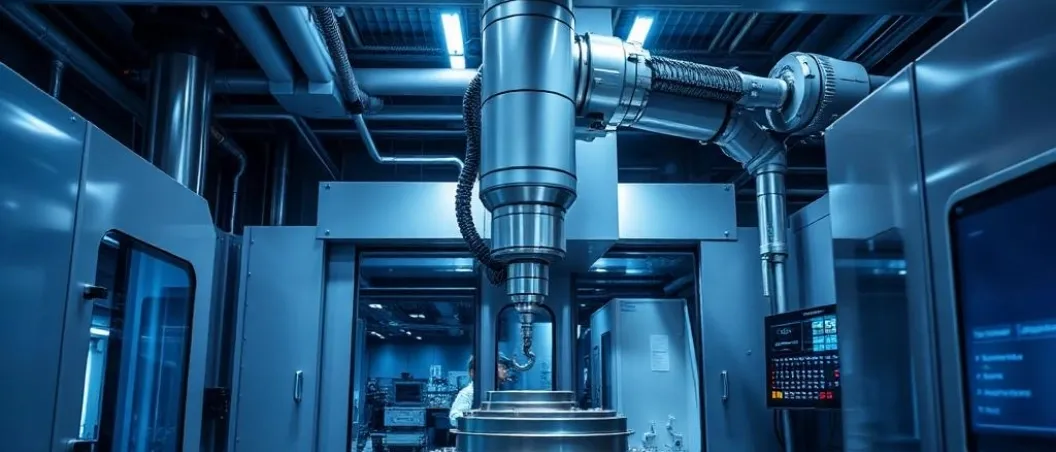
The most immediate benefit manufacturers see after integrating robotics is a sharp jump in productivity. Robots don't take breaks, don't get tired, and don't make mistakes due to fatigue. They can operate continuously-24 hours a day, 7 days a week-without operator intervention.
This constant operation translates directly to higher output. For example, advanced automation systems like CubeBOX have been shown to increase night shift efficiency by 50 percent, which can shorten the return on investment (ROI) window to just one year. When your CNC machines run unattended during off-hours, you're essentially doubling or tripling your production capacity without hiring additional staff.
Robots excel at repetitive tasks like loading and unloading parts, transferring materials between machines, and managing tool changes. By automating these labor-intensive operations, your skilled machinists can focus on more complex, value-added work-and your machines stay productive around the clock.
While the upfront investment in robotic systems can seem substantial, the long-term financial benefits are compelling. Robots reduce labor costs by automating repetitive tasks, eliminate overtime expenses, and minimize material waste through precision handling.
Beyond direct labor savings, robotics reduce operational costs in several ways:
The financial case for robotics has strengthened considerably. Modern advancements in AI and data analytics are boosting precision and operational efficiency, making the cost-benefit equation far more favorable than it was just a few years ago.
Robots don't have off days. They deliver the same level of precision, consistency, and accuracy every single time. This reliability is transformative for product quality.
When parts are loaded, positioned, and handled by robots, each component is placed exactly where it needs to be. This eliminates the variability that comes with manual handling and reduces production errors. The result is fewer defects, less rework, and higher customer satisfaction.
Robotic systems equipped with touch probes or 3D laser scanners can even automate first-article and in-process inspection tasks, measuring completed parts for dimensional accuracy right on the shop floor. This real-time quality control catches issues before they cascade through your production line, cutting cycle times and reducing bottlenecks at dedicated quality control stations.
For manufacturers producing complex or high-tolerance components, this level of consistency is non-negotiable. Robotics deliver it reliably.
Automation isn't about replacing your team-it's about protecting them. Robots handle the repetitive, physically demanding, and potentially dangerous tasks that often lead to workplace injuries.
Heavy lifting, awkward motions, and exposure to hazardous materials are exactly the kinds of jobs robots excel at. By automating these tasks, you:
Collaborative robots (cobots) take this further. Engineered with force-limiting sensors and safety features, cobots can work safely alongside human workers without bulky protective cages, creating a true human-robot partnership on the shop floor.
Modern manufacturing demands flexibility. Product mixes shift, customer requirements change, and production volumes fluctuate. Traditional fixed-function equipment can't keep up. Robotics can.
Reprogrammable CNC robots can be easily reconfigured to handle different tasks. Unlike equipment locked into a single function, robots can move from loading raw materials into a CNC mill one day to handling finished parts inspection the next. User-friendly interfaces mean operators of all skill levels can adjust job programs to meet different customer demands.
This adaptability is especially valuable for:
Mobile robotic units add another layer of flexibility. Designed with smaller footprints and increased portability, they can be deployed in tight spaces or moved between workstations as needed, making automation accessible even to smaller facilities without major facility overhauls.
Robotics don't exist in isolation. They're part of a larger ecosystem of Industry 4.0 technologies-IoT sensors, AI algorithms, cloud computing, and real-time data analytics.
When you integrate robotics into your CNC operations, you're tapping into:
This integration creates a connected, intelligent manufacturing environment where data flows seamlessly between robots, CNC machines, and management systems. The result is tighter synchronization, faster response times, and higher machine utilization rates.
Unplanned downtime is expensive. Every minute your CNC machines sit idle is lost revenue. Robotics, combined with AI-driven predictive maintenance, dramatically reduce these costly interruptions.
Machine learning algorithms analyze data from sensors-temperature, vibration, spindle load, and more-to predict failures before they happen. Early detection means:
By 2025, CNC shops leveraging AI for scheduling, programming, and maintenance can rapidly adapt to new job requirements and reduce unplanned outages significantly. This proactive approach to maintenance transforms downtime from a liability into a managed, predictable part of operations.
As your business grows, your automation needs to grow with it. Robotics offer modular, scalable solutions that expand with your operation.
Rather than investing in entirely new equipment, you can:
This modularity is particularly valuable for job shops and smaller manufacturers. You can start with one robotic cell, prove the ROI, and then scale up as your confidence and budget allow. Modular and reprogrammable systems are particularly advantageous for scaling, as they allow manufacturers to expand capabilities without significant additional investment.
Historically, implementing robotic automation required specialized expertise. Complex programming, steep learning curves, and the need for highly trained roboticists made automation inaccessible to many manufacturers. That's changing.
AI-powered programming tools and user-friendly software are democratizing automation:
By lowering the barriers to adoption, these advancements make CNC robotics a viable solution for manufacturing businesses of all sizes, from small job shops to large-scale factory operations. Your existing team can learn to operate and program robotic systems without requiring expensive external consultants or entirely new hires.
The manufacturing landscape is evolving rapidly. Technologies that seem cutting-edge today will be standard tomorrow. Investing in robotics now positions your operation for long-term competitiveness.
Robotic systems with open architecture control allow you to add new features and connect to smart systems as they emerge. Predictive maintenance capabilities help you fix problems before they stop your work. Collaborative partnerships with automation experts ensure you stay current with new technology.
By adopting robotics strategically, you're not just solving today's problems-you're building a foundation for tomorrow's innovations. Your operation becomes more agile, more resilient, and better positioned to adapt to whatever changes the manufacturing industry throws your way.
The benefits of CNC robotics are being amplified by several cutting-edge innovations:
Cloud-based CNC programming enables seamless collaboration between teams and quick adjustments to changing production demands. Centralized platforms enhance data security, reduce on-site infrastructure costs, and support predictive maintenance by analyzing machine performance trends.
Digital twins allow manufacturers to test new robotic systems and workflows virtually before deploying them physically. This reduces the time, cost, and errors typically associated with trial-and-error testing on actual equipment, providing a virtual testing ground for optimization.
Swarm robotics-multiple robots working together to complete complex tasks-represent a cutting-edge innovation for large-scale operations. By distributing tasks among a network of robots, manufacturers improve scalability, redundancy, and overall productivity.
Compact and mobile robotic units break down space constraints that have historically limited automation in smaller facilities. These units can be deployed in tight spaces or moved between workstations as needed, ensuring that even small-scale manufacturers can benefit from automation.
The evidence is clear: integrating robotics into your CNC operations delivers measurable, substantial benefits across productivity, cost, quality, safety, and scalability. The technology has matured. The business case is compelling. The barriers to entry have fallen.
The question isn't whether to automate-it's when and how to do it strategically. Axton Robotics specializes in helping manufacturers like you navigate this transition, from assessing your current operations to designing and implementing robotic solutions tailored to your specific needs.
Whether you're looking to increase output, reduce costs, improve quality, or future-proof your operation, the path forward starts with understanding how robotics can transform your specific workflow. The manufacturers thriving in 2025 and beyond will be those who embrace this transformation today.
Global demand for industrial robots continues to surge, with installations expected to grow by 6% to 575,000 units in 2025, surpassing 700,000 units by 2028. China remains the largest market, accounti…
Axton Robotics
Jan 10, 2025 — 7 min read
Smart manufacturing robotics now incorporate advanced AI vision systems that dramatically improve quality control processes. These robot vision systems provide real-time analysis, adaptive responses,…

Michael Nessem
Dec 5, 2024 — 2 min read