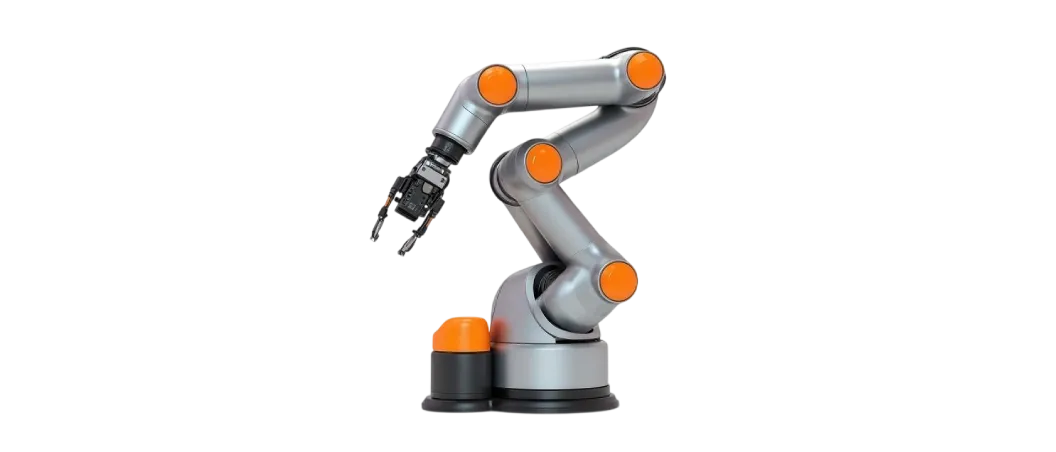
Cobots are designed to work safely alongside humans, sharing workspaces without the need for safety cages. They're equipped with advanced sensors, torque limiters, and intuitive programming interfaces, making them ideal for flexible, high-mix, low-volume environments.
Traditional robots are the workhorses of automation-powerful, fast, and precise. Typically operating in fenced-off zones, they excel at repetitive, high-volume tasks that demand speed, endurance, and heavy lifting.
Feature Cobots Traditional Robots
Safety Built-in sensors, work alongside humans Require safety cages/barriers
Programming Intuitive, user-friendly, drag-and-drop Complex, requires specialists
Flexibility Highly adaptable, easy to re-task Optimized for fixed, repetitive tasks
Speed & Payload Slower, lighter loads (7–77 lbs typical) Fast, heavy loads (up to 2,200 lbs)
Precision ±0.02–0.025 mm ±0.025 mm or better
Setup Time Hours to days Weeks to months
Cost $10,000–$50,000 $50,000–$200,000+
ROI Timeline 6–12 months 18–36 months
Ideal Use Case High-mix, low-volume, human collaboration High-volume, repetitive, heavy-duty
Floor Space Compact, fenceless Requires dedicated, fenced area
Cobots are engineered for safe, direct interaction with people. Their force sensors, speed limits, and instant stop features mean they can operate without cages, freeing up valuable floor space and enabling true human-robot teamwork. This makes them ideal for:
Cobots shine in dynamic production settings. Their lightweight, portable design and simple programming interfaces allow operators to re-task them in minutes-no advanced coding required. This agility is crucial for:
With entry prices starting around $10,000 and payback periods as short as six months, cobots offer a cost-effective entry point into automation, especially for small and medium-sized enterprises (SMEs). Their minimal integration and training costs further accelerate ROI.
Cobots are designed for ease of use. Operators can program them via drag-and-drop interfaces or by physically guiding the robot arm. This reduces the need for specialized robotics engineers and empowers existing staff to manage automation, supporting workforce development and retention.
Modern cobots often come equipped with advanced connectivity features, making it easier to integrate them into Industrial IoT platforms for real-time monitoring, predictive maintenance, and process optimization.
Traditional robots are built for speed, power, and precision. They can handle heavy payloads (up to 2,200 lbs), operate at high speeds (up to 2 meters/second), and deliver repeatable accuracy for millions of cycles. They are the backbone of:
For tasks that are dangerous, dirty, or dull, traditional robots excel. Their ability to operate in harsh environments and perform hazardous operations-such as welding, die casting, or chemical handling-makes them indispensable in heavy industry.
When output volume and consistency are paramount, traditional robots deliver. Their robust construction and advanced control systems ensure minimal downtime and uniform product quality, even under 24/7 operation.
While the initial investment is higher, traditional robots are scalable for large factories with stable, long-term production needs. They can be integrated with conveyor systems, vision systems, and other automation for synchronized, high-efficiency workflows.
Cobots
Pros:
Cons:
Pros:
Cons:
No. Cobots complement rather than replace traditional robots. Many factories deploy both, using cobots for flexible, collaborative tasks and traditional robots for high-speed, high-volume operations.
Cobots shift the focus from manual labor to technical and supervisory roles. Workers learn to program, maintain, and optimize cobot stations, increasing job satisfaction and career growth opportunities.
Industries with high-mix, low-volume production-such as electronics, medical devices, and custom manufacturing-see the greatest benefits. Cobots are also valuable in sectors facing labor shortages or requiring ergonomic improvements.
Most cobots can be installed and programmed in hours or days, compared to weeks or months for traditional robots. This rapid deployment minimizes disruption and accelerates ROI.
Choosing between cobots and traditional robots depends on your production goals, workforce, budget, and future growth plans. Many forward-thinking factories are blending both technologies to maximize flexibility, safety, and throughput.
If you're seeking expert guidance on integrating automation into your operations, Axton Robotics offers tailored solutions and deep industry expertise. Our team can help you assess your unique needs and design a roadmap for smart, scalable automation.
The future of manufacturing is collaborative, agile, and data-driven. Whether you're scaling up with traditional robots or unlocking new efficiencies with cobots, the right automation strategy will set your factory apart. Explore how Axton Robotics can help you harness the full potential of robotics-contact us today to start your journey toward smarter, safer, and more profitable production.
Global demand for industrial robots continues to surge, with installations expected to grow by 6% to 575,000 units in 2025, surpassing 700,000 units by 2028. China remains the largest market, accounti…
Axton Robotics
Jan 10, 2025 — 7 min read
Smart manufacturing robotics now incorporate advanced AI vision systems that dramatically improve quality control processes. These robot vision systems provide real-time analysis, adaptive responses,…

Michael Nessem
Dec 5, 2024 — 2 min read